Maturity. Boredom. And the Future of Slovenia.
Oct 06, 2025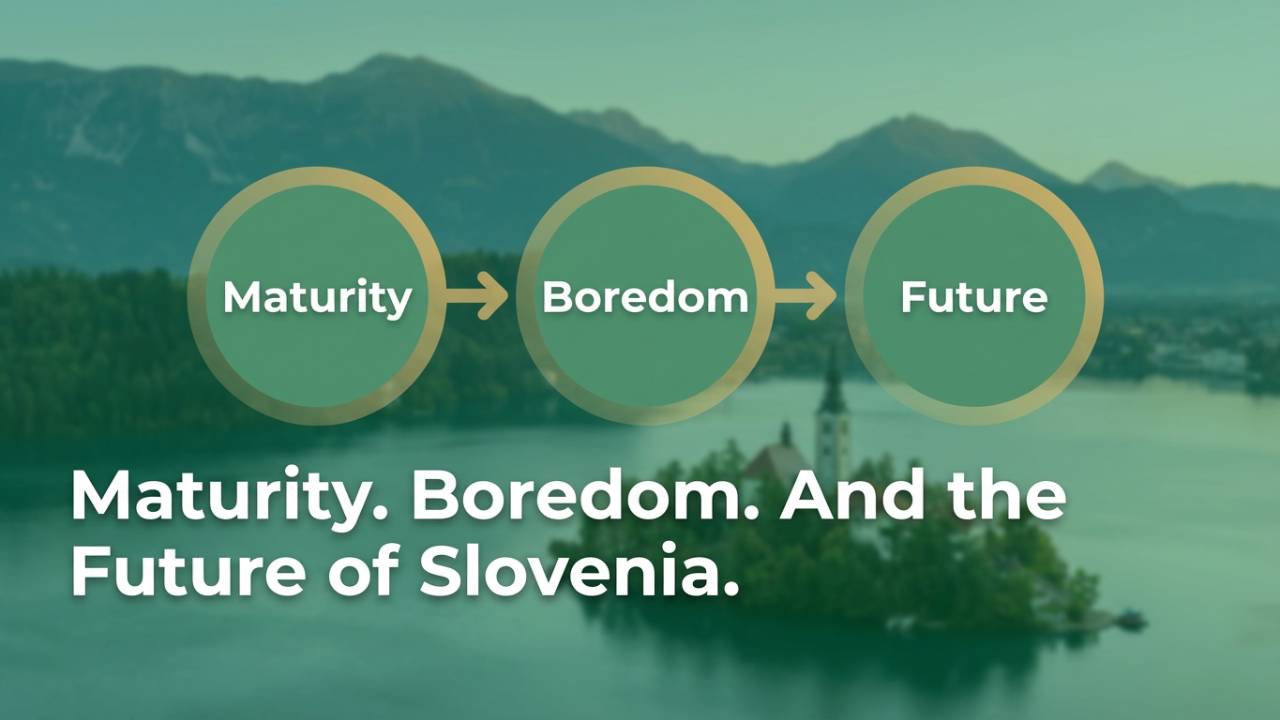
Here is a clear, faithful, and well-crafted English translation, keeping the depth, rhythm, and intent of the original (not polished away, not softened):
Maturity. Boredom. And the Future of Slovenia.
The Congress of the Managers’ Association surprised me.
Pleasantly. Deeply. And above all — inspiring in a different way.
This time, I noticed a shift that is strategically important for the business community: values appeared on the main stages that we have not heard in business discourse for a long time.
Collaboration. Empathy. Connection. Long-term orientation. Trust.
These are not soft topics — they are the foundations of competitive societies of the future.
For the first time, I sensed a conversation about leadership maturity:
the space between reaction and reflection,
between strength and softness,
between individual initiative and collective awareness.
And this shift is not small.
For organizations, it signals a new management paradigm — a move from crisis mode to a developmental way of operating.
“The paradox of national success: BOREDOM.”
Jonathan Terra — a lecture that got under my skin.
On one of the slides it said:
“The paradox of national success. What is the fundamental characteristic that defines the world’s most successful societies? BOREDOM. Northern Europe, Canada, Australia & New Zealand.”
A sentence that grabbed me.
My inner developmental psychologist jumped to attention.
Boredom? Seriously? The foundation of national success?
When I reflected on this through the lens of individual, team, and systemic development, it became clear:
“boredom” is simply another word for less drama.
Less crisis.
More inner stability.
More capacity to stay with complexity without impulsive reactions.
In the economy, this means:
-
less short-term firefighting, more strategic consistency,
-
fewer ad hoc solutions, more structured development,
-
less need for external validation, more inner clarity and collective responsibility.
Maturity = less drama = more space for conscious creation of long-term value.
When we are in drama, we are in a reactive system.
Our responses are not conscious — they are conditioned by unconscious needs, fears, and unresolved wounds.
Maturity means we stop confusing tension with vitality.
What if… maturity is exactly what we are missing most — as a country, and as individuals?
Not another tax reform (although that would matter).
Not a new person at the top.
Not new hope that collapses after three months.
Not reliance on politics.
But US.
Maturity.
Maturity as structure.
Maturity as systemic capacity.
Maturity as the ability to step out of the adolescent phase of a nation and enter an era of responsibility.
Slovenia is 34 years old.
And like any 34-year-old… it should already know who it is and what it wants.
Yet as a nation, we still often react like a rebellious teenager:
a bit cynical, a bit offended, often without a clear vision and without awareness of long-term consequences.
And meanwhile… time keeps moving.
We are losing children.
Losing a shared vision.
Losing a mature space where future generations could anchor themselves with trust.
Maturity as a national project
What if Slovenia’s next major development project were precisely a project of maturity?
📍 Not another marketing campaign.
📍 Not another “start-up mindset” incubator.
📍 But serious investment in the capacities of young people, individuals, teams, and systems for a vertical developmental leap.
From the heroic leader to a holder of space for collective intelligence.
From schools of grades to education for maturity and wholeness.
From political drama to structured searching for solutions for the future.
I know — part of this sounds naïve.
But how else, if not naively?
What if we stopped waiting for politicians to grow up…
…and instead, as mature citizens, began educating them, inviting them into structured dialogue, and holding them within shared goals?
I’m aware someone will say: utopia.
But every breakthrough began with an idea that was first dismissed as “too much.”
If maturity is the key to success — why wouldn’t we be the first country to offer development as a service?
If boredom means we’ve finally outgrown our own drama — why wouldn’t we find strength in that?
And if boredom scares you…
maybe it’s time to ask yourself:
Am I ready for more maturity — in myself, in my team, in our society?
The Earth.
The children.
Our future selves.
They would all thank us.